When a leading EV manufacturer needed end-of-line testing and calibration equipment installed at their production facility, they turned to a large integrator to engineer the systems — and that integrator turned to Nationwide Services to get them in the ground.
The project was anything but routine. Four distinct automation systems, nine major machines, and a five-to-seven-week window per system to support a new vehicle production launch. There was no room for delays and no margin for error.
What We Installed
The scope covered the full mechanical and electrical installation of four critical end-of-line systems:
Rear Suspension Pre-Aligners — Two servo-driven alignment machines with nutrunner wings, servo stands, and overhead cable tray systems. These were the first to go in, setting the pace for the rest of the project.
ADAS Calibration Systems — Two target gantry systems complete with test enclosures, integrated lighting, sprinkler tie-ins, and operator stations. These systems ensure every vehicle’s advanced driver-assistance features are dialed in before it leaves the plant.
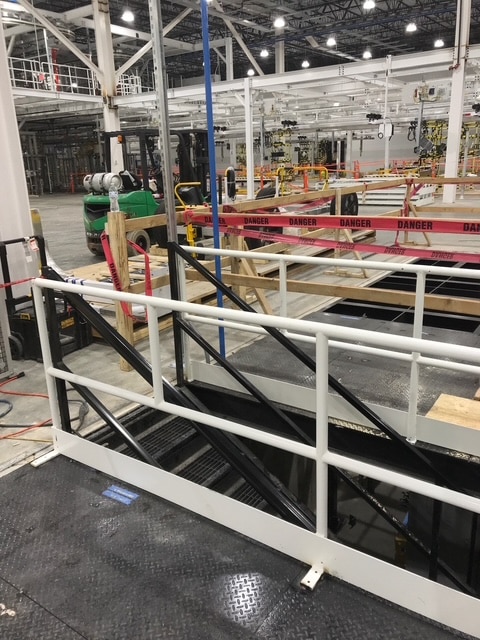
Wheel Alignment / Headlamp Aimers (WAHA) — Three heavy-duty alignment machines requiring pit floor construction, operator lifters, headlight shuttles, and a master gage gantry. The heaviest equipment on the project, with individual machines exceeding 15,000 lbs.
Dynamic Vehicle Testers (DVT) — Three cradle roller testers housed in purpose-built sound booths, with pit construction, roll-up doors, and HMI operator stands. These simulate real-world driving conditions to verify vehicle performance before delivery.
A True Turnkey Scope
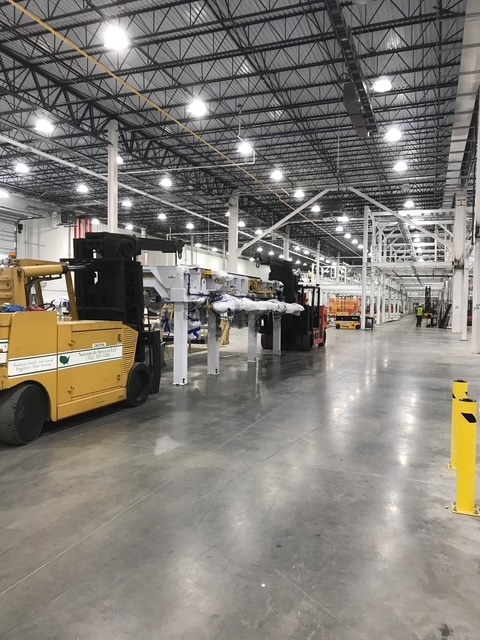
Nationwide Services handled every aspect of installation across both mechanical and electrical disciplines. That meant rigging and precision-placing equipment weighing up to 15,000 lbs per plant layout drawings, then leveling, anchoring, and lagging every machine, control panel, and support structure to the facility floor.

On the electrical side, our subcontractors connected all 480V power, low-voltage controls, Ethernet communications, and operator station wiring. We built out overhead cable tray support structures with full cable routing, termination, and testing. Pneumatic headers were assembled with station drops and leak-checked before handoff.
The work didn’t stop at the machines themselves. We constructed sound enclosures, assembled pit steel floors and stairwells, installed operator lifters, and built out roll-up door assemblies. Safety systems — fencing, light curtains, and emergency stop devices — were installed throughout. We even handled sprinkler system construction with tie-ins to the facility’s existing fire suppression infrastructure within the pits and booths.
Coordination That Made It Work
A project of this complexity doesn’t succeed without tight coordination. Our team participated in daily morning whiteboard meetings with the integrator’s field service management, tracking progress and managing a live punch list through final buyoff at every milestone.
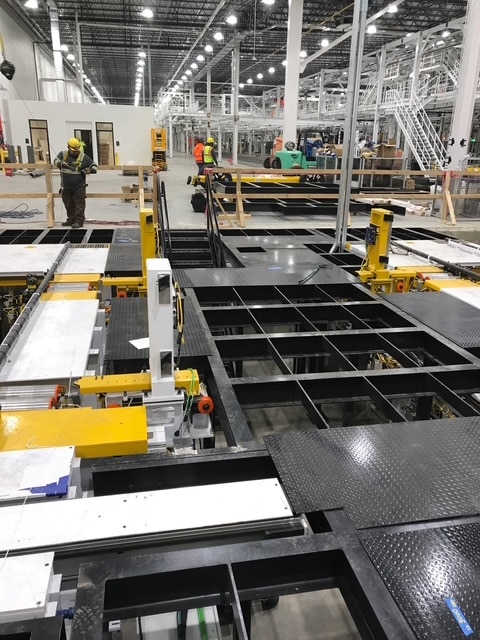
All work was performed in strict compliance with NEC, OSHA, and local building codes, as well as the manufacturer’s proprietary engineering standards covering equipment safety buyoff, tooling safety, risk assessment, industrial control panels, concrete anchoring, and site infrastructure requirements.
Results
The numbers speak for themselves:
- All four system installations delivered on schedule within the compressed timeline
- Nine major machines across four distinct system types installed simultaneously
- Full compliance with the manufacturer’s rigorous safety and quality buyoff standards
- All rigging equipment, lifts, tooling, and supervision provided with zero additional charges for scope adjustments
- Successful integrator buyoff verification at each installation milestone
Why It Matters
End-of-line systems are the last checkpoint before a vehicle reaches its owner. The precision required to install ADAS calibration targets, wheel alignment machines, and dynamic vehicle testers is measured in thousandths of an inch — and the timeline pressure of a new vehicle launch doesn’t make that any easier.
This project is a clear example of what Nationwide Services brings to large-scale automation installation: the skilled trades, the equipment, the coordination, and the commitment to deliver on time in environments where the schedule doesn’t bend.